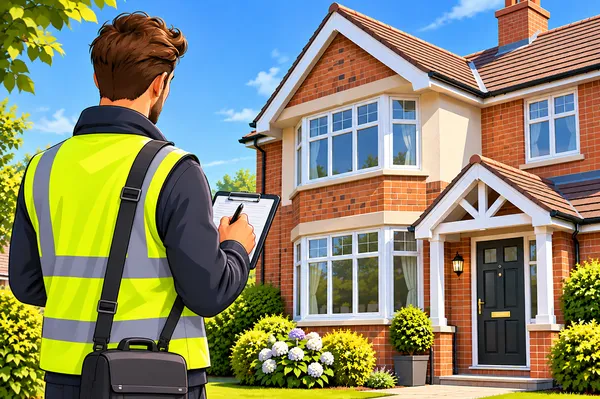
A RICS Level 2 Home Survey is a mid-level, visual inspection of a property's condition, designed for conventional homes in reasonable condition. It replaced the old HomeBuyer Report and gives you a clear, traffic-light rated report on the main parts of the building, flags urgent or serious defects and tells you where further investigation is needed.
Key points
- It is one of three survey levels in the RICS Home Survey Standard (Level 1, 2 and 3).
- It suits standard-construction homes in fair condition, including most modern houses and flats.
- It is available with or without a market valuation.
- It typically costs around £400-£900, depending on the property.
What does a Level 2 Home Survey include?
The surveyor carries out a non-intrusive visual inspection of the inside and outside of the property. That usually covers:
- Outside: chimneys, roof coverings, rainwater pipes and gutters, main walls, windows, external doors, and other joinery.
- Inside: the roof space (if safely accessible), ceilings, walls, floors, fireplaces, built-in fittings and internal woodwork.
- Services: a visual look at electricity, gas, water, heating and drainage, where visible. These are observed, not tested.
- Grounds: garages, outbuildings (main ones), boundaries and other features within reasonable view.
- Risks: issues that could affect the building, the grounds or people, such as signs of movement, damp, or potentially hazardous materials.
The report also includes a section of matters for your conveyancer to check, such as guarantees, planning consents and building regulations approval for alterations.
How does the report work?
Each element is given a condition rating:
- 3 - defects that are serious and/or need to be repaired, replaced or investigated urgently.
- 2 - defects that need repairing or replacing but are not considered serious or urgent.
- 1 - no repair is currently needed. Normal maintenance applies.
- NI - not inspected.
You get a summary at the front, so you can see the key issues quickly, followed by more detail for each section. Our guide on how to read your survey report walks through this in more detail.
What does a Level 2 survey not cover?
A Level 2 is deliberately limited, and it helps to know where the edges are:
- The surveyor will not move heavy furniture, lift fitted carpets or floorboards, or open up the structure.
- Services are not tested. If something looks unsafe or old, you will be advised to get a specialist check.
- The roof is inspected from ground level and from the loft hatch or roof space if it is safe. The surveyor will not climb onto the roof.
- It does not give detailed repair advice or cost estimates. Where the cause of a problem is unclear, the surveyor will typically recommend further investigation.
- Legal issues such as boundaries, rights of way and title are for your conveyancer.
If you need more detail than this, a Level 3 Building Survey is the better fit.
Which properties is a Level 2 suitable for?
A Level 2 works well for:
- Houses and bungalows of conventional brick or block construction.
- Flats in purpose-built blocks or conversions where the building is in reasonable order.
- Homes from roughly the 1920s onwards that have not been heavily altered.
- New or nearly new homes, once any snagging is done (see do I need a survey on a new build home?).
It is less suitable for listed buildings, older period homes with original or altered fabric, unusual construction, or homes in clearly poor repair. Our Level 2 vs Level 3 guide helps you choose if you are on the fence.
Level 2 with or without a valuation?
There are two versions:
- Level 2 survey only - the condition report.
- Level 2 survey with valuation - the same report plus the surveyor's opinion of the market value and an insurance reinstatement cost (the estimated cost to rebuild, used for buildings insurance).
A valuation is useful if you are worried you are overpaying, if you are buying with cash and have no lender's valuation, or if the survey finds issues you want to reflect in the price. Read more in Level 2 survey with valuation: when is it worth adding?
How much does a Level 2 survey cost?
Prices typically sit around £400-£900. The main factors are:
- The value of the property (higher value usually means a higher fee).
- Size and number of rooms.
- Location, with some areas, especially London and the South East, typically costing more.
- Whether you add a valuation.
Fees vary between surveyors, so a figure outside that range is not necessarily wrong. Always check what is included before you book.
How long does it take?
The inspection on an average family home usually takes a few hours. The surveyor then writes up the report, which typically arrives within a few working days. Booking quickly after your offer is accepted helps keep the purchase on track.
Who carries out a Level 2 survey?
Level 2 surveys under the RICS Home Survey Standard are carried out by RICS members. Other regulated surveyors, such as members of the Residential Property Surveyors Association (RPSA), offer comparable mid-level home surveys under their own frameworks. Our guide to RICS vs RPSA surveyors explains the difference.
Whoever you use, check that they are regulated, carry professional indemnity insurance and know the local area. Local knowledge matters, because surveyors familiar with an area will know its typical construction, ground conditions and common defects.
What should you do with the results?
A Level 2 report almost always finds something. Most homes, even good ones, will have a few condition rating 2 items. Focus on:
- Anything rated 3, especially structural movement, roof failures, significant damp or safety issues.
- Recommendations for further investigation. Get these done before exchange, not after.
- Items your conveyancer needs to check, such as missing consents.
From there you can proceed, renegotiate or, in rare cases, walk away. See how to renegotiate the price after a bad survey.
Book a Level 2 survey
Book A Surveyor finds a regulated independent surveyor near the property, agrees a fixed price, liaises with the estate agent for access and takes payment, so the survey is booked without you chasing quotes. Learn more about the Level 2 Home Survey, see how it works, or get a fixed-price survey booked.
Get your survey booked, not quoted
Fixed price up front. We find a local RICS or RPSA surveyor, arrange access with the agent and confirm the date.
See your priceFrequently asked questions
Is a Level 2 Home Survey the same as a HomeBuyer Report?
Broadly, yes. The RICS HomeBuyer Report was replaced by the Level 2 Home Survey under the RICS Home Survey Standard, and many people still use the old name. The current product is the Level 2, with or without a valuation.
How much does a Level 2 Home Survey cost?
A Level 2 typically costs around £400-£900, depending on the value, size and location of the property. Adding a valuation usually increases the price.
Will a Level 2 survey find damp?
The surveyor will look for visible signs of damp and often use a moisture meter on accessible walls. They will rate any problem and may recommend a specialist investigation, but they will not open up walls or floors to find hidden damp.
Can a Level 2 survey be done on a flat?
Yes. A Level 2 is commonly used for flats. The surveyor inspects the flat itself and the parts of the building visible from it and from the grounds, but not the whole block in detail.
Do I get a valuation with a Level 2?
Only if you choose the Level 2 survey with valuation option. The survey-only version gives no market value or reinstatement cost.
Related guides
Buy-to-let surveys: what landlords should check before they buy
Buying a rental property? Which survey landlords need, what to look for so the home passes safety and lettings standards, and how it ties in with your buy-to-let mortgage.
Choosing a surveyBuying a flat: which survey and what to check
Which survey to get when buying a flat, what a surveyor can and can't inspect in a block, and the lease and building checks that matter.
Choosing a surveyBuying a house with an extension or loft conversion: survey guide
Buying a home with an extension or loft conversion? Which survey to choose, common defects, and the paperwork your conveyancer should check.