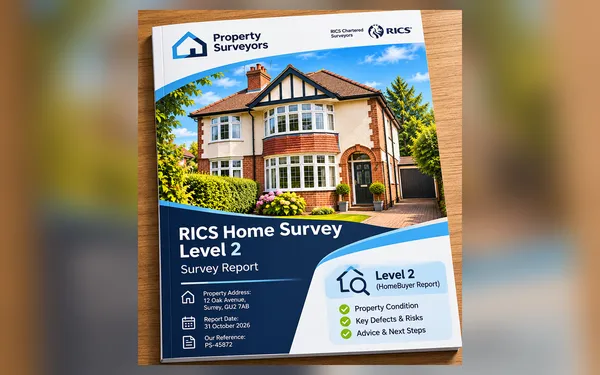
A Level 2 Home Survey suits most conventional homes built in the last 100 years or so that are in reasonable condition. A Level 3 Building Survey is the better choice for older, larger, unusual or altered properties, or any home you plan to renovate, because it inspects more thoroughly and explains defects, causes and repair options in more detail.
Key points
- Both are defined by the RICS Home Survey Standard and use the same 1/2/3 condition ratings.
- Level 2 is a mid-level inspection for standard homes in fair condition; Level 3 is the most detailed survey available.
- Level 3 typically costs a few hundred pounds more than Level 2, but is still small compared with the cost of an unexpected repair.
- Age alone does not decide it - condition, construction, alterations and your plans matter just as much.
What is the difference between a Level 2 and Level 3 survey?
Both surveys are carried out by a regulated surveyor who walks through the property, inspects the visible and accessible parts of the building and writes a report. The difference is depth.
A Level 2 Home Survey (previously known as the HomeBuyer Report) covers the main elements of the building and flags problems with a traffic-light condition rating. The surveyor does not move furniture, lift floorboards or open up anything, and if they see a concern they may recommend further investigation rather than diagnosing it themselves.
A Level 3 Building Survey involves a more thorough inspection. The surveyor will look more closely at roof spaces, under accessible floors where practical, and at the detail of the structure. The report typically explains what is causing a defect, how it might be repaired, how urgent it is and, often, a rough idea of cost or the type of contractor you need.
Side-by-side comparison
| Level 2 Home Survey | Level 3 Building Survey | |
|---|---|---|
| Best for | Conventional homes in reasonable condition | Older, larger, unusual, altered or run-down homes |
| Inspection | Visual, non-intrusive, main elements | More thorough, wider scope, more time on site |
| Report detail | Condition ratings with concise comments | Detailed descriptions, likely causes, repair options |
| Valuation | Optional add-on | Not standard, can often be added |
| Typical price | Around £400-£900 | Around £600-£1,500+ |
Prices vary with the value, size and location of the property, so treat these as typical ranges rather than fixed figures.
When is a Level 2 survey enough?
A Level 2 is usually the right choice when:
- The home is of standard construction (brick or block walls, a pitched tiled or slate roof).
- It is in reasonable condition, with no obvious signs of major neglect.
- It has not been substantially altered, or the alterations are recent and documented.
- You are not planning major building work straight away.
Typical examples include post-war and modern semis, terraces built in the last few decades and well-kept 1930s houses. For a lot of buyers, a Level 2 gives a clear picture at a sensible price. If you want an opinion on value too, you can choose a Level 2 survey with valuation.
When should you choose a Level 3 survey?
A Level 3 is worth the extra cost when the property is more complex or the risks are higher. Consider it if the home:
- Was built before around 1900, or is a period property of any age with original features. See our guide to surveys for Victorian and period homes.
- Is listed or in a conservation area.
- Is of non-standard construction, such as timber frame, thatch, or concrete systems.
- Has been extended, converted or substantially altered. Our guide to buying a house with an extension or loft conversion covers this in more detail.
- Shows signs of movement, damp or long-term neglect.
- Is large, or has outbuildings and grounds you want looked at.
- Is one you plan to renovate, so you want to understand the fabric before you start.
If you are unsure, a Level 3 is the cautious option. Paying a few hundred pounds more for detail is rarely regretted on a house that turns out to need work.
How do the reports differ in practice?
Both reports use the same condition ratings:
- Condition rating 3 - defects that are serious and/or need to be repaired, replaced or investigated urgently.
- Condition rating 2 - defects that need repairing or replacing but are not considered serious or urgent.
- Condition rating 1 - no repair is currently needed, with normal maintenance.
- NI - not inspected.
The difference is what sits around those ratings. In a Level 2 report, a crack in a wall might be rated 2 or 3 with a short explanation and a recommendation to get a structural engineer's opinion. In a Level 3, the surveyor is more likely to describe the crack, give their view on the probable cause, say whether it looks historic or ongoing and explain what kind of repair is likely. That extra context is useful when you are deciding whether to proceed or how to renegotiate the price after a bad survey.
How long does each survey take?
Inspection times depend on size and condition, but as a rough guide a Level 2 on an average three-bedroom house usually takes a few hours on site, while a Level 3 often takes longer, sometimes most of a day for a large or complicated property. Reports typically arrive within a few working days of the inspection, with Level 3 reports sometimes taking a little longer because they are more detailed.
What neither survey covers
Neither survey is a guarantee that the property is defect-free. Both are visual inspections within the limits of what the surveyor can safely see and access on the day. They do not:
- Test electrics, gas, drains or heating systems in the way a specialist would.
- Lift fitted carpets or floorboards that are fixed down, or move heavy furniture.
- Cover legal matters such as boundaries, planning consent or title, which are your conveyancer's job.
Where the surveyor sees a risk, they will usually recommend a specialist report, for example from an electrician, a drainage contractor or a structural engineer.
What about the mortgage valuation?
Your lender will carry out its own valuation, but that is for the lender's benefit, not yours. It confirms the property is suitable security for the loan and is not a survey of condition. Our guide to mortgage valuation vs survey explains why it is not a substitute.
How to decide quickly
Ask yourself three questions:
- Is the property conventional and in decent condition? If yes, a Level 2 is likely enough.
- Is it old, unusual, altered or in visibly poor repair? If yes, go for a Level 3.
- Are you planning significant work? If yes, a Level 3 will give you a much better starting point.
If the answers point in different directions, speak to the surveyor before booking. A good surveyor will tell you honestly if a Level 2 is enough or if a Level 3 is wise. You can also read our dedicated Level 2 vs Level 3 comparison page.
Get the right survey booked
Once you know which level you need, the next step is finding a local regulated surveyor with availability. Book A Surveyor finds an RICS or RPSA regulated independent surveyor near the property, agrees a fixed price, arranges access with the estate agent and takes payment, so you get a booked survey rather than a list of quotes to chase. See how it works or get a fixed-price survey booked.
Get your survey booked, not quoted
Fixed price up front. We find a local RICS or RPSA surveyor, arrange access with the agent and confirm the date.
See your priceFrequently asked questions
Is a Level 3 survey always better than a Level 2?
Not always. A Level 3 goes deeper, but for a conventional, modern home in reasonable condition a Level 2 usually gives you what you need at a lower price. The right choice depends on the property, not on picking the most expensive option.
Can I upgrade from a Level 2 to a Level 3 after booking?
Usually yes, as long as you change before the inspection takes place. Once the surveyor has visited, upgrading normally means a second visit and a new fee, so it pays to decide at the start.
Does a Level 3 survey include a valuation?
Not by default. A Level 3 Building Survey does not include a market valuation as standard, although many surveyors will add one for an extra fee if you ask.
Which survey do I need for a house built in the 1930s?
Many 1930s homes are standard brick construction and suit a Level 2 if they are unaltered and in fair condition. If the house has been extended, has visible movement or needs significant work, a Level 3 is the safer choice.
Do mortgage lenders require a Level 2 or Level 3 survey?
No. Lenders only require their own mortgage valuation. The survey is optional and is for your protection, so you choose the level.
Related guides
Buy-to-let surveys: what landlords should check before they buy
Buying a rental property? Which survey landlords need, what to look for so the home passes safety and lettings standards, and how it ties in with your buy-to-let mortgage.
Choosing a surveyBuying a flat: which survey and what to check
Which survey to get when buying a flat, what a surveyor can and can't inspect in a block, and the lease and building checks that matter.
Choosing a surveyBuying a house with an extension or loft conversion: survey guide
Buying a home with an extension or loft conversion? Which survey to choose, common defects, and the paperwork your conveyancer should check.