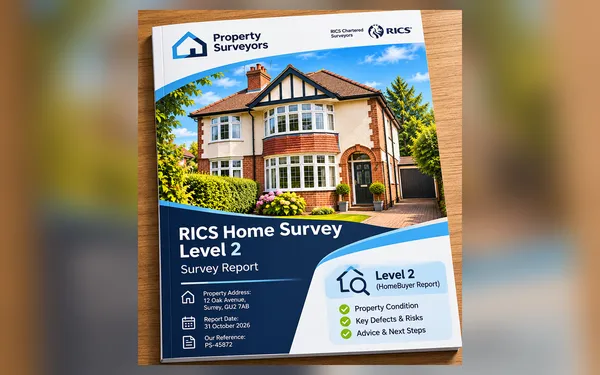
A RICS survey report rates each part of the property using condition ratings: 3 for serious or urgent defects, 2 for defects that need repair but are not serious or urgent, and 1 for no repair currently needed, with NI meaning not inspected. Start with the summary and every condition rating 3, then work through the 2s and anything marked NI. Then call the surveyor to talk through what matters most.
Key points
- Condition rating 3: serious and/or urgent. Act on these before exchange.
- Condition rating 2: needs repair, but not serious or urgent. Budget for it.
- Condition rating 1: no repair currently needed. Normal maintenance only.
- NI: not inspected. Ask whether further checks are worthwhile.
- Recommendations for further investigation should be followed before you commit.
What are condition ratings?
The RICS Home Survey Standard uses a simple traffic-light style system across Level 1, Level 2 and Level 3 reports. Each element of the property (roof coverings, chimneys, walls, windows, services and so on) gets a rating.
| Rating | Meaning | What to do |
|---|---|---|
| 3 | Defects that are serious and/or need to be repaired, replaced or investigated urgently | Get advice and quotes before exchange |
| 2 | Defects that need repairing or replacing but are not considered serious or urgent | Budget for the work |
| 1 | No repair is currently needed | Normal maintenance |
| NI | Not inspected | Ask the surveyor if further checks are needed |
The ratings are a guide, not a verdict on whether to buy. A report full of 2s is normal for a 100-year-old house. A single 3 can be minor (a cracked roof tile letting in water) or major (structural movement).
How should I read the report?
1. Start with the summary
Most reports open with a summary of condition ratings, often a table or list that shows every element and its rating. This gives you the big picture in a minute or two.
2. Read every condition rating 3 in full
Go to each section rated 3 and read the explanation carefully. Ask yourself:
- What exactly is the problem?
- Is it a safety issue?
- Does the surveyor recommend a specialist or further investigation?
- Could it affect the value, your mortgage or your insurance?
3. Work through the condition rating 2s
These are the jobs you will probably have to do in the next few years. Individually they may be small, but repointing, replacing windows, new guttering and decorating can add up to a lot.
4. Check the NIs
If a key area was not inspected, such as the roof space or sub-floor void, find out why. Sometimes it is just clutter or locked access, and a return visit or specialist check is worthwhile.
5. Read the "further investigations" and legal sections
Reports usually list:
- Further investigations: specialist checks such as an electrical inspection, gas safety check, drainage CCTV survey, structural engineer or timber and damp specialist. Get these done before exchange where possible.
- Issues for your legal adviser: things your solicitor should check, such as building regulations approval for an extension, planning permission, guarantees, rights of way or lease terms.
- Risks: to the building, the grounds and people, such as flood risk, trees near the house or the presence of materials that may contain asbestos.
Pass the legal section straight to your solicitor or conveyancer.
What if there are no repair costs in the report?
Many Level 2 and Level 3 reports do not include cost estimates. Some surveyors offer rough guidance, but for most decisions you need proper quotes from contractors. These are especially important if you want to renegotiate the price.
Common items that worry buyers
Some findings sound alarming but are common and manageable. Others need real attention. A few examples:
- Damp readings. High moisture readings could be rising damp, penetrating damp, condensation or a leak. The cause matters more than the reading. See damp in a survey report.
- Cracks. Many cracks are cosmetic or from minor historic movement. Wide, tapering or recent cracks are more significant. See cracks in walls: when to worry.
- Roof issues. Slipped tiles are a small job, while a roof near the end of its life is a big cost. See common roof problems surveyors find.
- Electrics. Older consumer units and wiring often get flagged with a recommendation for an electrical test. See what a surveyor checks on electrics and gas.
Talk to your surveyor
The single best thing you can do with your report is call the surveyor. They know the property and can tell you:
- Which issues they would be most concerned about.
- Which are typical for the age and type of property.
- What further investigations they would prioritise.
- Roughly what scale of work is involved.
Prepare your questions first. Our guide to questions to ask your surveyor has a list.
Turning the report into action
Once you understand the report, decide what to do:
- Proceed as planned if the findings are minor or expected.
- Get specialist reports or quotes for anything rated 3 or flagged for investigation.
- Renegotiate if the costs are significant and were not reflected in the price.
- Ask the seller to fix specific issues before exchange.
- Walk away if the problems are too serious or uncertain. See should you pull out after a bad survey?
Did I get the right survey?
If your report has lots of NIs or recommends a more detailed survey, you may have needed a Level 3 rather than a Level 2. Our guide to Level 2 vs Level 3 explains when each is appropriate.
Get a survey you can act on
A clear report from a regulated local surveyor makes all of this easier. Book A Surveyor finds a RICS or RPSA regulated surveyor with availability, agrees a fixed price and arranges access with the estate agent. Get a fixed-price survey booked.
Get your survey booked, not quoted
Fixed price up front. We find a local RICS or RPSA surveyor, arrange access with the agent and confirm the date.
See your priceFrequently asked questions
What does condition rating 3 mean?
Condition rating 3 means a defect that is serious and/or needs urgent repair, replacement or further investigation. These are the items to deal with first, before exchange of contracts.
Should I be worried about lots of condition rating 2s?
Not necessarily. Condition rating 2 covers defects that need repair or replacement but are not serious or urgent. Most older homes have plenty of them, but they still add up, so budget for them.
What does NI mean on a survey?
NI means not inspected. The surveyor could not see or access that part of the property, so the report cannot comment on its condition. Ask whether a further inspection is worth arranging.
Does a survey report include repair costs?
Level 2 and Level 3 reports do not always include repair costs. Some surveyors add guidance on costs, but for negotiation you should get quotes from contractors.
Can I ask my surveyor to explain the report?
Yes. Most surveyors are happy to talk you through the report by phone, and it is one of the most useful things you can do once it arrives.
Related guides
Buying a house when you're self-employed: mortgage, survey and timing
Self-employed and buying a home? What lenders look for, how long it takes, and how to time your survey so a slower mortgage doesn't cost you the house.
Costs and processDown valuation: what to do if your mortgage valuation comes in low
Your lender valued the house below the price you agreed. Here is why down valuations happen and your five realistic options, from renegotiating to switching lender.
Costs and processFirst-time buyer timeline: mortgage, survey and conveyancing in the right order
A step-by-step timeline for first-time buyers in England, from agreement in principle to completion, showing when to book your mortgage, survey and conveyancer.