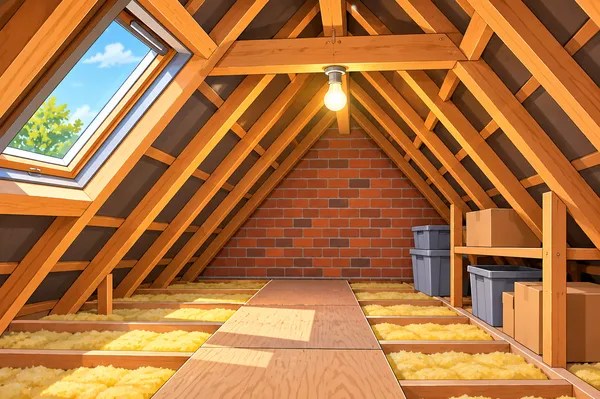
Surveyors flag spray foam insulation because it can hide the roof timbers, trap moisture against them and make many mortgage lenders reluctant to lend. They flag cavity wall insulation because, in the wrong building or the wrong location, it can allow damp to cross the cavity. Neither is automatically a deal breaker, but both need checking before you exchange, and spray foam in particular can affect your mortgage.
Key points
- Spray foam applied to the underside of roofs often prevents the surveyor inspecting the timbers.
- Many lenders treat spray foam cautiously and may need a specialist inspection report.
- Closed-cell foam bonded to the roof tends to cause more concern than open-cell foam.
- Cavity wall insulation is usually fine, but can cause penetrating damp in exposed locations.
- Ask the seller for installation paperwork, guarantees and any inspection reports.
What is spray foam insulation?
Spray polyurethane foam is sprayed onto the underside of a pitched roof, between and over the rafters, where it expands and sets. It was widely marketed to homeowners as a way to cut heating bills and to secure loose slates or tiles. There are two main types:
- Open-cell foam - soft, spongy and vapour permeable.
- Closed-cell foam - rigid, denser and acts as a vapour barrier.
Why do surveyors flag spray foam?
The timbers cannot be inspected
When foam covers the rafters and the underside of the roof covering, the surveyor cannot see the condition of the timbers, battens or underlay. They will state that these areas were not inspected, which limits what the report can tell you about the roof.
Risk of trapped moisture and decay
If foam has been applied without proper assessment of ventilation and moisture, water vapour or small leaks can be trapped against the timbers, potentially leading to rot that goes unnoticed for years. This risk depends on the specification, installation and the building, not just the presence of foam.
Lending and valuation issues
Many mortgage lenders have been cautious about spray foam since around 2022. Some decline to lend, some ask for a specialist inspection report, and some apply their own criteria depending on foam type and condition. A lender's valuer may report it, and a lender may refer the case for manual review or ask for further information before making an offer.
Removal is difficult and costly
Closed-cell foam bonded to the underside of slates or tiles can make it hard to reuse the covering, and removal is messy. Even where removal is possible, the roof may need repairs afterwards.
What guidance exists on spray foam?
RICS published a consumer guide on spray foam insulation in 2023 to help homeowners understand the issues. A working group set up by the Property Care Association (PCA) and the Residential Property Surveyors Association (RPSA), including lenders, surveyors, insurers, certification bodies and the spray foam industry, produced an inspection protocol for assessing spray foam in pitched roofs. It guides surveyors through a non-invasive visual inspection focusing on the condition of the foam and the risk factors for the specific roof, rather than its presence alone.
Lender attitudes continue to evolve, so always check current policy with your lender or broker.
What should you do if a house has spray foam?
- Ask the seller for paperwork. Installer details, product type, certification, date of installation and any guarantee.
- Speak to a mortgage broker early. They will know which lenders are currently more flexible.
- Get a specialist spray foam inspection if your surveyor or lender recommends it. Choose an inspector working to the industry protocol.
- Consider the future. Even if you can get a mortgage, your eventual buyer may struggle. Factor that into your offer.
- Get removal quotes if removal is likely to be required, and use them in any renegotiation.
What about cavity wall insulation?
Most houses built from the 1920s onwards have cavity walls, and millions have had insulation injected into the cavity, often through government-backed schemes. In the right building, it works well. Surveyors flag it because:
- In exposed locations, such as hilltops, coasts and west-facing elevations subject to driving rain, water can track across the insulation to the inner leaf, causing penetrating damp.
- Poor installation can leave gaps, cold spots or debris in the cavity that bridge moisture.
- Defective outer walls, with cracked render, failed pointing or leaking gutters, make problems more likely.
- Some materials, particularly older fibre or foam fills, may have settled or degraded.
The surveyor will usually note drill holes in the mortar joints as evidence of retrofitted insulation, and look inside for damp patches on the inner face of external walls. Our damp in a survey guide explains how penetrating damp shows up.
What paperwork should you ask for on cavity wall insulation?
Ask the seller for:
- The installation date and installer.
- A Cavity Insulation Guarantee Agency (CIGA) guarantee, which typically lasts 25 years for qualifying installations, or another guarantee.
- Any reports of problems or claims.
Your conveyancer can raise these as enquiries. A CIGA guarantee can be valuable if problems later turn out to be caused by the installation.
What about other retrofit insulation?
Spray foam and cavity fill are the most common concerns, but surveyors also comment on other energy efficiency work, such as external wall insulation, internal wall insulation on solid walls and loft insulation. Poorly detailed retrofit work can create cold bridges, trap moisture or cover up defects. If the seller has had insulation installed recently, ask for paperwork and any guarantees.
Lenders are also paying more attention to how insulation was installed, particularly where homes were improved under government or energy company schemes. If an Energy Performance Certificate lists insulation measures, compare it with what the surveyor actually finds.
Which survey is best?
A Level 2 Home Survey will identify spray foam and evidence of cavity wall insulation and flag any visible issues. A Level 3 Building Survey gives more detail on the construction, the likely risks and what to do next, which is helpful if the property is older, exposed or has other alterations. Whichever you choose, the survey is your chance to spot these issues before you are committed.
If you want a regulated surveyor to look at the property, get a fixed-price survey booked and we will arrange access with the estate agent. See how it works for more.
Get your survey booked, not quoted
Fixed price up front. We find a local RICS or RPSA surveyor, arrange access with the agent and confirm the date.
See your priceFrequently asked questions
Can I get a mortgage on a house with spray foam insulation?
It depends on the lender, the type of foam and its condition. Some lenders will lend with a satisfactory specialist inspection report, while others decline or ask for removal. Speak to a broker early and expect the valuer to report it.
What is the difference between open-cell and closed-cell spray foam?
Open-cell foam is soft and vapour permeable, while closed-cell foam is rigid and acts as a vapour barrier. Closed-cell foam bonded to the underside of the roof covering tends to cause more concern because it can trap moisture and makes slates and tiles hard to reuse.
How much does it cost to remove spray foam insulation?
Costs vary with the roof size, foam type and how well it is bonded, but removal and making good typically runs to several thousand pounds. Closed-cell foam is usually harder and more expensive to remove than open-cell.
Is cavity wall insulation a problem when buying a house?
Most cavity wall insulation performs well. Problems arise mainly in exposed, wind-driven rain locations, where walls are in poor condition, or where installation was poor. Ask for the installation date, the installer and any CIGA guarantee.
Will my surveyor tell me if spray foam is a problem?
Your surveyor will report spray foam if they see it and comment on what they can observe, but the foam itself often hides the roof timbers. They may recommend a specialist inspection following the industry protocol for spray foam assessments.
Related guides
Asbestos in older homes: what a survey report means
Asbestos mentioned in your survey? Where it is found in UK homes built before 2000, what the surveyor's comments mean and when to get it tested.
Defects and problemsBuying in a former coal mining area: surveys and searches
Buying a home on the old coalfield? What a CON29M coal mining search shows, what a survey adds and what to do if a mine shaft is nearby.
Defects and problemsCommon roof problems surveyors find
The roof problems surveyors find most often, from slipped slates and nail sickness to flat roof failure and sagging, and what each means for you.